Lately, two completely opposite—yet equally anxiety-inducing—narratives have flooded the internet. On one side are viral short videos claiming that “anyone with zero coding background can build websites and apps with AI in ten minutes.” On the other side are bleak warnings that “AI is so powerful now that coding is dead, and kids studying computer science won’t be able to find jobs.”
As an engineer with years of hands-on experience working across frontend, backend, and product collaboration—and having just partnered with AI to build and stabilize the very global multilingual community you are reading right now—my conclusion is the exact opposite: this is not the time to stop learning computer technology; rather, it is the single best era to combine computer fundamentals, software architecture, and AI.
1. From a “Ten-Minute AI Demo” to a “Global Production Platform”: A World of Systems Engineering
Undeniably, today’s AI can spin up a visually impressive landing page or a neat local utility in minutes. Yet the moment you set out to build a serious platform serving global users reliably over the long haul, you quickly realize that “a page that opens” and “a system that withstands the real world” are two entirely different beasts.
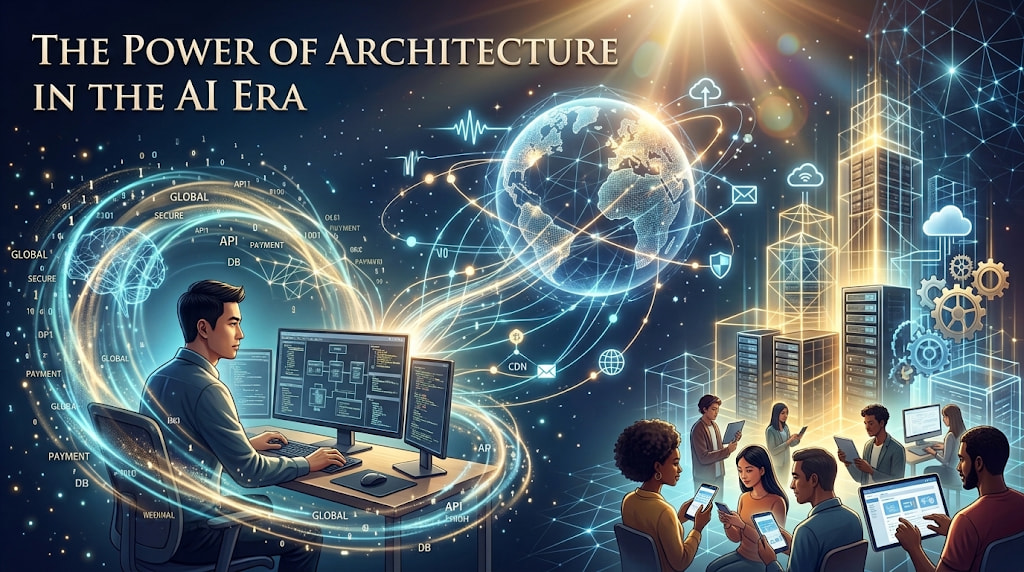
Take the site right in front of you. Behind the scenes, making sure visitors from dozens of countries can load pages instantaneously and interact safely relies on an interlocking set of internal mechanisms and infrastructure:
-
Global foundational architecture and delivery: To ensure seamless loading of text, images, and media worldwide, the backend coordinates cloud servers, independent cloud object storage, a global Content Delivery Network (CDN), and high-deliverability email infrastructure so verification and notification emails don’t vanish into spam folders.
-
Rigorous community security and anti-abuse mechanisms: The moment a public community goes live, it faces daily bot scans and spam attacks. Internally, the platform runs a tiered user trust system that dynamically adjusts posting, uploading, and interaction privileges based on genuine member activity—paired with secure third-party OAuth logins and independent backups—keeping the community clean without getting in the way of real members.
-
Automated payment and permission loops: Handling member subscriptions and donations is far more complex than slapping a static payment QR code onto a page. The backend integrates live recurring billing with encrypted server-side webhook verification: whenever a member subscribes, renews, or cancels, the system automatically updates their exclusive badges, private category access, and real-time chat permissions in real time—with zero manual intervention.
-
Deep multilingual localization and real-world polish: To let readers across 8 languages feel completely at home while ensuring search engines in every region index the content accurately, we configured multilingual dictionaries, cross-language routing, and painstakingly tracked down device-specific quirks like narrow mobile screen layouts and dark-mode flickering.
The reason non-technical beginners rarely manage to build a flagship platform like this with AI usually comes down to two roadblocks. First is a lack of architectural judgment, which leads them to ask AI to stitch together a fragile, vulnerability-ridden system from scratch. Second is “black-box troubleshooting” across interconnected services. When image uploads fail, payment callbacks don’t trigger, or access lags in a specific country, the culprit could lie anywhere across DNS records, caching rules, server permissions, API secrets, or browser compatibility. In those moments, AI frequently offers outdated or hallucinated fixes; without the human ability to inspect logs layer by layer and isolate the root cause, you quickly get trapped in an endless loop with the AI.
2. One Person Doing the Work of a Team: An Amplifier for Seasoned Builders
Think back to how software used to be built. Shipping a complete, polished product typically required assembling product managers, frontend developers, backend engineers, and operations specialists. Anyone who has worked on real teams knows that a huge portion of the energy wasn’t spent creating—it was burned on communication overhead, aligning interfaces, and endless back-and-forth rework.
AI has completely rewritten that equation.
AI has never been about replacing people who understand computing—it replaces mechanical “syntax typists.” What it multiplies exponentially are practical builders who grasp the big picture, stay patient, and know how to debug layer by layer.
When an engineer who has worked across frontend experience, backend logic, and product thinking—and who carries real-world scars from shipping actual projects—collaborates deeply with AI, a remarkable shift happens. The human owns system architecture, technology selection, security reviews, and layered troubleshooting, while AI acts like a tireless elite execution crew, rapidly generating code modules, assisting with localization, and running tests.
The result isn’t merely that one person working with AI can match the output of an entire small team. Because the architectural vision and product intent live seamlessly inside a single mind—free of departmental silos and communication friction—the finished system often turns out cleaner, deeper, and more cohesive than one pieced together by a traditional team.
3. How Should We—and the Next Generation—Learn Technology in the AI Era?
So if you are debating whether to pick up technical skills yourself, or wondering whether your children should study computer science in the future, my answer is clear: it is still deeply worth learning, but the focus must evolve.
-
Don’t obsess over obscure syntax—build solid software architecture fundamentals: In the past, learning to code meant spending countless hours memorizing syntax quirks and writing repetitive boilerplate. AI can handle that now. What truly holds value is understanding how computing systems work underneath—how data flows, how frontend and backend communicate, where network and security boundaries sit, and how separate services integrate.
-
Integrate AI into learning instead of letting it replace thinking: Learn how to articulate requirements clearly and break complex problems down for AI. Even more importantly, cultivate an eye for code review and debugging—when AI hands you a solution, you need to spot performance bottlenecks or logical flaws immediately rather than blindly copying and pasting.
-
Accumulate real “end-to-end project experience” early: As entry-level grunt-work roles shrink, pure theory is worth less than ever. Even if the project is small, take a real idea from architectural design and implementation all the way through deployment and ongoing maintenance alongside AI. Every real bug you diagnose in a live environment becomes practical intuition that AI can never take away from you.
The faster tools evolve, the more irreplaceable holistic vision, systems thinking, patience, and steadiness become. AI is an unprecedented super-amplifier—yet what it ultimately builds still depends on the person standing behind the screen, patiently turning a blueprint into reality step by step.
Have you tried using AI to build a website, create a tool, or solve a technical challenge? What are your thoughts on learning coding or guiding the next generation’s skills in the AI era? Feel free to share your experiences below.
Further Reading: Beyond technical architecture and hands-on engineering, if you’d like to explore humanity’s truly irreplaceable soul advantage, the power of choice, and how awakened creativity builds the “New Earth Matrix” in the age of AGI, continue with the companion post: What Is Humanity’s Most Precious Advantage in the AI Era? — AI Can Only Design; Only Passion and Sincerity Can Choose